Every social app seems to add a search bar eventually, and once people start trusting it, the app starts behaving like a search engine. That’s what happened with Instagram, TikTok, LinkedIn, and Facebook.
Social search optimization (sometimes called social SEO) means writing your captions, profiles, on-screen text, and listing titles in the plain language people type into a platform’s search bar, so your content surfaces when someone searches inside the app instead of scrolling past it in a feed.
These apps are now where someone looks up how to unclog a sink, decides whether a jacket is worth the money, or sizes up a vendor before answering their email. The feed still gets the attention, but a growing share of real buying decisions starts in that search box.
Are Hashtags Still Relevant?
Bolting 30 hashtags to a post was standard practice for years, and a whole cottage industry of hashtag generators, free and paid, grew up around it. Then, in December 2025, Instagram head Adam Mosseri announced that Instagram now caps hashtags at five per post, saying “a few specific tags actually perform better than a long list of generic ones.”
We wouldn’t call hashtags completely obsolete, though. By Mosseri’s own description, they help with search; they just “don’t increase your reach.” A few relevant tags still help the platform file your post under the right topic, and a branded campaign hashtag still earns its keep. Following hashtags, on the other hand, is gone: Instagram no longer supports it.
The shift is from using hashtags as a reach lottery, to using them like SEO keywords: fewer, more targeted, platform-specific.
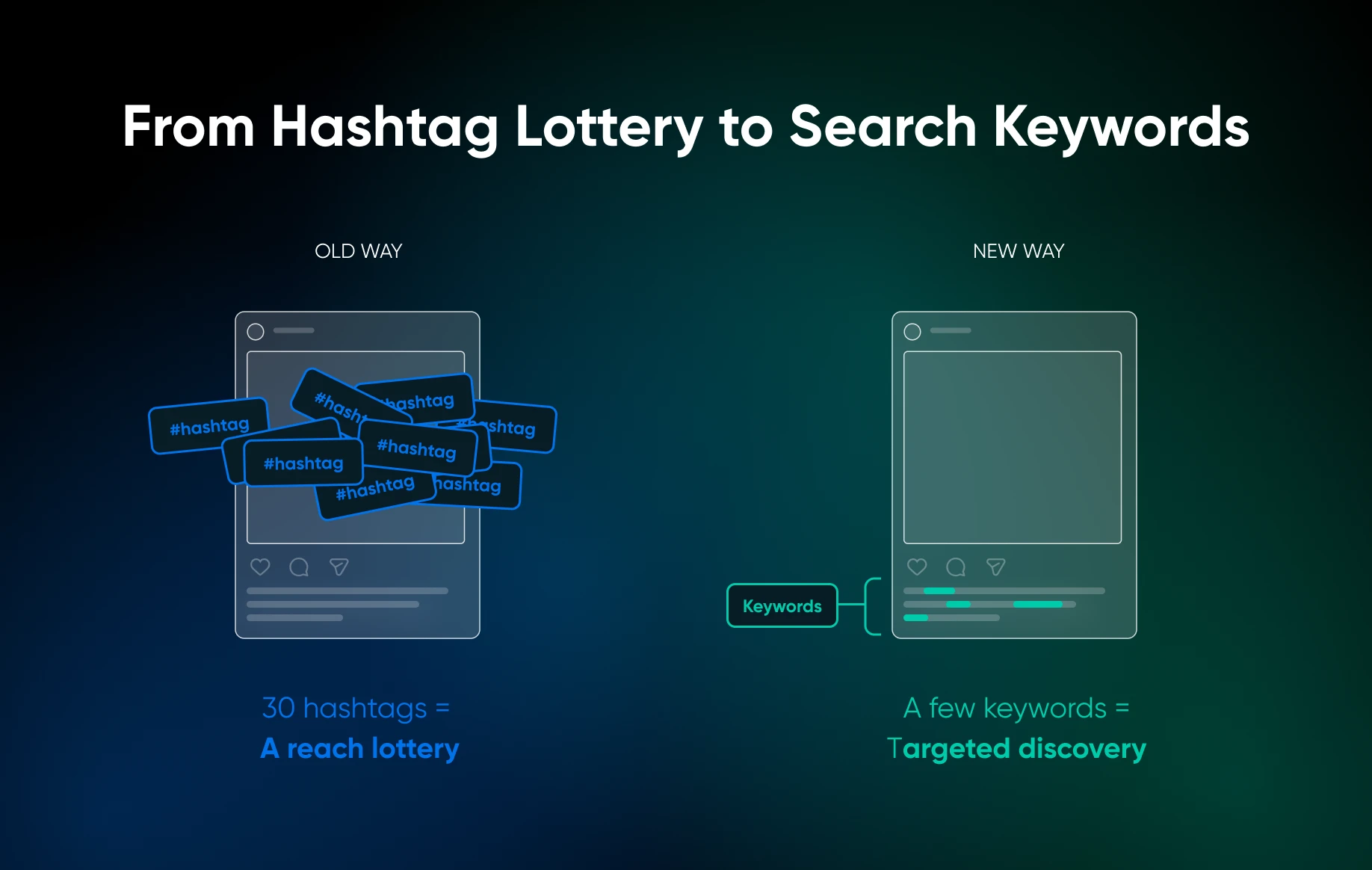
Instead of a hashtag, you now have to write like a person describing what’s in the image or video that you’re posting. Native search reads the language inside your content to decide what to rank.
1. Instagram
Instagram launched in October 2010 as a photo-sharing app, the kind where you ran a square photo of your lunch through a sepia filter and behaved like a documentary photographer.
For years it stayed a polished, visual-first place built around the still image. Then it “implemented” the Stories feature that Snapchat had, then Reels after TikTok, and somewhere in that “borrowing” spree it became the video-scrolling machine it is today.
People on Instagram come to look. Your image or video has to earn the stop, and your words are left to do the less glamorous work of telling Instagram, and now Google, what the pretty thing in front of them actually is.
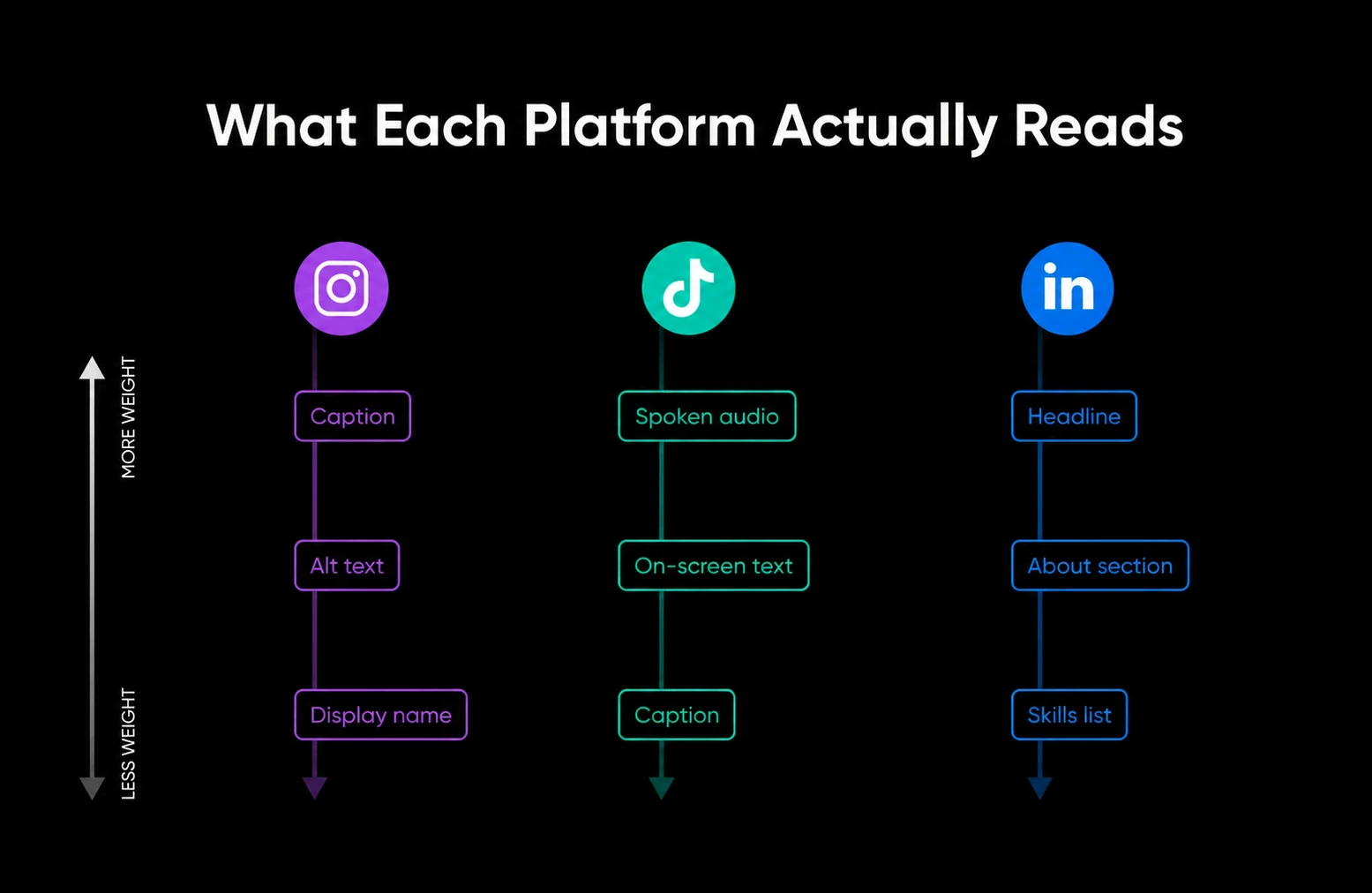
There are three fields that carry weight, and each rewards different handling:
- The caption is the heavyweight, and its first line behaves like a headline, so the phrase a person would search belongs up at the top.
- Alt text is easy to forget, which is exactly why filling it in is such a cheap edge: it’s plain-language, discoverable text describing your image for Instagram search and Google alike.
- Give your display name real words to match: “Maya’s Bakery | Austin Sourdough” hands search something to work with; a cleverly misspelled handle hands it nothing.
The Signal You Should Care About
Instagram has a lot of vanity metrics, just like any other platform.
You have likes, you have comments, you have views, but Mosseri keeps pointing at “sends” as the metric to optimize for. It’s the number of times someone decides a post is good enough to fire off to a friend in a DM, and for reels, sends via DM are the most heavily weighted distribution signal.
That is a high bar, and it should be, because nobody forwards a forgettable post.
And your caption is now working two jobs. Since July 10, 2025, Instagram allows search engines to index public posts from professional accounts of users over 18. It’s on by default, with an opt-out in settings. A Reel that walks through how to season a cast-iron pan can resurface months later for a stranger typing exactly that into a search engine, long after it has scrolled out of every feed it ever touched.
2. TikTok
TikTok never set out to be a search engine. It set out to be a slot machine for video, an endless For You feed tuned to keep your thumb moving.
People started searching it anyway. In Adobe Express’s January 2026 survey, 49% of U.S. consumers had used TikTok as a search engine, up from 41% in 2024. And in TikTok’s own 2025 research with WARC, 86% of U.S. Gen Z internet users said they search on TikTok weekly. The queries are usually the kind that are easier to watch than to read: how to fix a leaky faucet, whether a cordless vacuum is worth buying, where to eat in a new city.
The reason is trust. A polished top result reads like marketing. A 23-second clip of a real person showing the thing reads like a friend who happens to own it.
Because TikTok is video-first, make the topic clear in three places:
- Spoken audio: name your topic out loud, ideally in the first line of dialogue.
- On-screen text: stamp the same keyword on the screen, where a muted viewer catches it too.
- The caption: the easiest to skim past, so treat it as backup rather than the whole pitch.
Fill all three, and you have told TikTok exactly what the clip is about.
The platform takes its own search seriously enough to sell against it. It launched Search Ads Campaign in the U.S. in September 2024, keyword-based ads that target the search results page, citing its own data that 23% of users search for something within 30 seconds of opening the app. And in that 2025 WARC study, 61% of TikTok search users said its search results are more likely to inspire action than results on other platforms.
Before you ever hit record, open Creator Search Insights, TikTok’s free research tool: type “Creator Search Insights” into the app’s search bar, and it shows trending searches and flags “content gaps”, topics with high search volume but little content answering them. Those neglected searches are wide-open doors. Pick one, build a video around the question, and answer it in the first three seconds, before the thumb decides for you.
3. LinkedIn
LinkedIn has grown into a real publishing platform, the place where business buyers size up vendors and people long before anyone picks up a phone. It is also where otherwise reasonable adults write posts that open with “I am humbled to announce,” but that’s a different book.
To optimize for LinkedIn, here are the fields worth your attention:
- Your headline should read like a query a buyer would run; if you already have a following you can afford to be clever, but for smaller profiles, every bit of edge helps.
- Your About section is room to describe the problems you solve in full sentences, in the language your buyers actually use.
- Load your skills list with the terms people look for, not the ones on your org chart.
The aim is to be the name that surfaces when someone searches the problem you solve.
4. Facebook
Facebook is the platform people have been declaring dead since roughly 2016, which is a strange thing to keep saying about a service that passed 3 billion monthly active users back in 2023.
The old playbook is gone, though. Posting to a brand Page and expecting reach is a little like tacking a flyer to a board in an empty town. The crowd hasn’t left Facebook, it’s just gathered in two new places:
- Groups are organized around a topic, and the name is how anyone can tell what that topic is: Prefer a descriptive Group name such as “Portland Container Gardening” over a clever brand-voice name that hides the topic, then measure whether it leads to join requests.
- Marketplace is a product search engine, where people arrive having already decided to buy and simply type in what they want: For physical and local goods, that intent runs about as warm as it gets, and it owes nothing to your follower count.
So write your posts, Group names, and listing titles the way a searcher would phrase them, and the visibility mostly takes care of itself.
Tracking the Right Metrics
Most of the numbers these apps put in front of you are designed to feel good. Track metrics that indicate whether people found your content and acted on it.
- On Instagram, that means saves and sends.
- On TikTok, track average watch time and whatever search-impression data you can pull, then revisit Creator Search Insights to confirm your keyword is matching real queries instead of the ones living in your head.
- On LinkedIn, watch profile views and inbound messages in the two or three weeks after you rewrite a headline, since that is the cleanest before-and-after you will get on the platform.
- On Facebook, count join requests and in-Group engagement, and treat Page reach as a vanity number.
If you run a public Instagram professional account for a user over 18, check your site analytics for visits arriving from Google; eligible Instagram posts may appear in external search results. If your site is hosted with DreamHost, the built-in Traffic Dashboard shows visits and traffic sources right in the panel, with no tracking code to install.
Write for the Search Box, Not the Feed
The common thread across all four platforms is that the feed is no longer the only way in. Instagram, TikTok, LinkedIn, and Facebook have each grown a search layer, and the posts that surface there are the ones written in the plain language people actually type, not the ones stuffed with hashtags or polished into marketing.
| Platform | Where the keyword goes | Signal to watch |
|---|---|---|
| First line of the caption, alt text, display name | Saves and sends | |
| TikTok | Spoken audio, on-screen text, caption | Watch time, search impressions |
| Headline, About section, skills list | Profile views, inbound messages | |
| Group names, Marketplace listing titles, public posts | Join requests, in-Group engagement |
That changes the job. Instead of chasing a moment of reach, you’re describing your content clearly enough that the right person finds it on purpose: the searchable phrase up top in a caption, the topic said out loud in a clip, the query written into a headline, the Group named the way someone would look for it.
For eligible public Instagram professional posts, external indexing creates another route to discovery after the feed moves on: a stranger may find the question you answered through a search engine later.
Social Search Optimization FAQs
Is social SEO different from traditional SEO?
The principle is identical: describe your content in the words a searcher would type. The mechanics differ. Traditional SEO optimizes pages, titles, and links on a website; social SEO optimizes the text and speech inside posts and profiles: captions, spoken audio, on-screen text, alt text, and profile fields.
Do Instagram posts show up in Google search results?
Yes. Since July 10, 2025, Instagram allows search engines to index public photos, videos, carousels, and Reels from professional (business and creator) accounts of users over 18. The setting is on by default, and you can switch it off in your privacy settings. Personal and private accounts are not included.
How many hashtags should I use?
On Instagram, five is now the hard limit per post, announced in December 2025, and Adam Mosseri says a few specific tags perform better than a long list of generic ones. On Instagram, treat hashtags as topic labels rather than a reach tactic, and put the real effort into a searchable caption.
Is TikTok really a search engine?
For a growing share of people, yes. In Adobe Express’s January 2026 survey, 49% of U.S. consumers had used TikTok as a search engine, up from 41% in 2024, and TikTok has sold keyword-based search ads in the U.S. since September 2024. Treat each video’s spoken audio, on-screen text, and caption like a page you’re optimizing.
How do I know if social search optimization is working?
Track the signals that map to intent: saves and sends on Instagram, average watch time and search impressions on TikTok, profile views and inbound messages on LinkedIn, and join requests on Facebook. Then check your website analytics for Google referrals, since indexed public posts can send visitors who never opened the app.